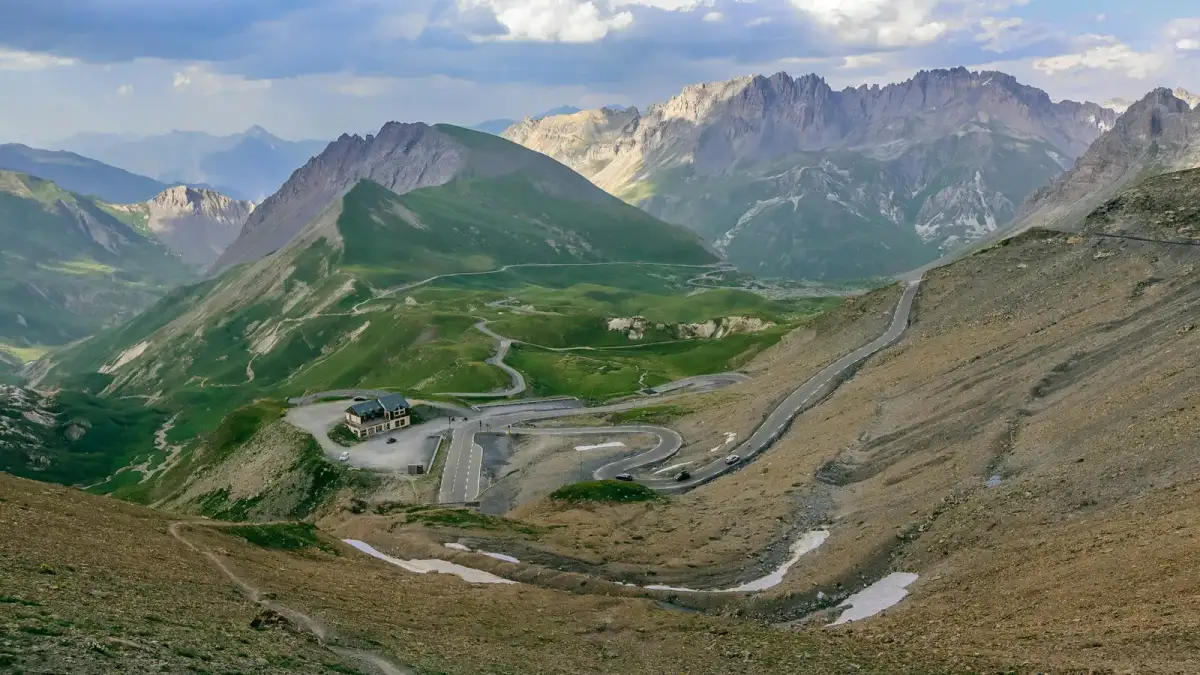
The French Alps are, alongside Mallorca, the destination European road cyclists plan their year around — and the Route des Grandes Alpes is the ride of a lifetime that threads it all together: roughly 700 km from Lake Geneva to the Mediterranean over a chain of legendary cols. You don’t have to ride it end-to-end to taste it. Base yourself in the Oisans valley and the biggest names in the sport — Alpe d’Huez, the Galibier, the Croix de Fer — start from your hotel door.
The Route des Grandes Alpes
The classic itinerary runs from Thonon-les-Bains on Lake Geneva to Nice on the Mediterranean: the most direct version is about 758 km with roughly 19,600 m of climbing, crossing a string of high passes that includes the Col de l’Iseran — at 2,764 m the highest paved pass in the Alps — and the Galibier. Most riders take eight to ten days, though credit-card tourers and organised trips do it in anything from five days to two weeks.
It’s a route, not a race: the roads are public and normally quiet outside July weekends, waymarked as the Route des Grandes Alpes®, and every stage town has grown up around passing cyclists. The catch is the calendar — the highest cols only open once the snow is cleared, typically late May to mid-June, and can close again from October.
The Oisans: cycling’s most famous valley
Bourg d’Oisans, a small market town an hour southeast of Grenoble, sits at the foot of the most famous climb in the sport: Alpe d’Huez, 13.8 km at 8.1% average over 21 numbered hairpins. The Tour de France has finished on the Alpe dozens of times since 1952, and on any summer morning the lower ramps are busy with riders pacing their own attempt.
The same valley serves the Col de la Croix de Fer (a long, irregular ~29 km haul with mid-climb descents) and the Col du Lautaret, from which the mighty Galibier is a final 8.5 km at close to 7%. That density is why La Marmotte — one of Europe’s oldest and most oversubscribed granfondos — starts in Bourg d’Oisans and finishes atop the Alpe every summer.
When to go
The dependable window is mid-June to mid-September. Before that, the high passes are often still closed or freshly opened between snow walls (the Galibier and Iseran openings vary year to year); after late September the weather turns fast at altitude. July brings the Tour de France circus and the fullest roads; June and September are the connoisseur months — open cols, mild valley temperatures, quieter hotels.
Valley bases like Bourg d’Oisans (about 720 m) stay warm even when the summits are cold: carry layers, because a 1,800 m descent at dusk is a different climate from the climb that earned it.
Where to stay
Bourg d’Oisans is the natural base: flat rides to the foot of five major climbs, bike shops on the main street, and hotels that have looked after cyclists for decades — locked bike rooms, wash stations and workshops are standard kit here rather than luxuries. Staying up at Alpe d’Huez itself puts you at 1,830 m for altitude nights and means finishing every ride with the famous hairpins.
The hotels below are ones whose cyclist facilities are documented — each listing links the source, so you can check the claims yourself before you book.
Sources
Cyclist amenities are self-reported by each hotel and sourced where possible — please confirm the details that matter to you directly with the hotel before booking.